
What in the World?!
Nicodemus: Part One

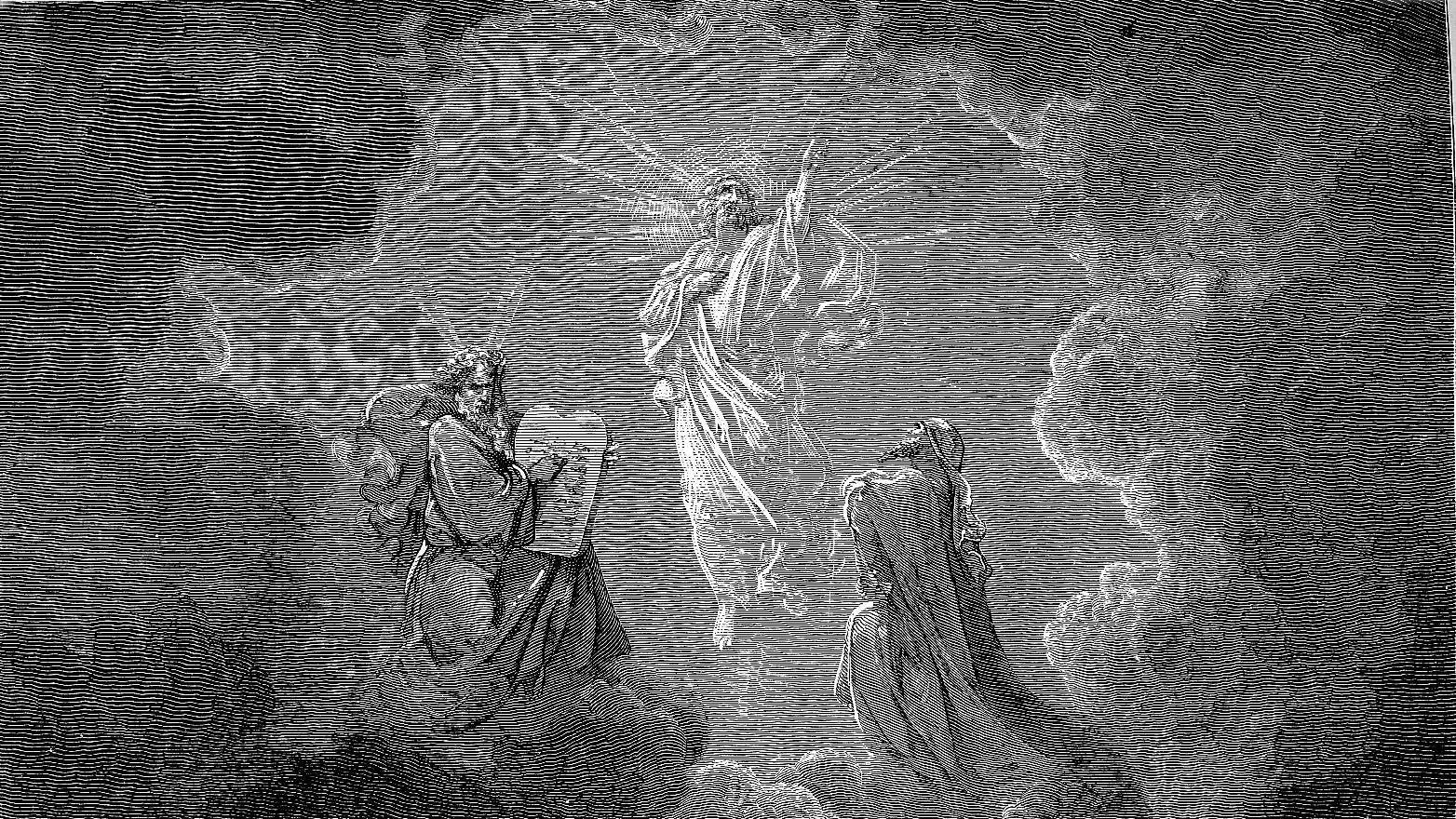
*Gustave Doré -The Transfiguration, 1866
“I don’t know if I’m ever going to want to read John 3 again.”
I told a dear friend that a few weeks ago. Months spent looking at the same twenty one verses, Knowing as I turn the corner to John 4 here soon, I’ll end up back here before I submit my dissertation in a few years.
Turning the same ideas over, finding new problems hiding behind old ones.
Each day facing the question again: What in the world is going on here?
Welcome to the inner workings of a New Testament PhD, where the reading you thought you were comfortable with gets unsettled, and there is always more waiting for you in, around, and behind the text.
This is the first of three four posts on Nicodemus. Today: John 3:1–12, who he is, and what Jesus does to everything he knows. Next week, what Jesus builds in its place. The week after, where the Gospel leaves Nicodemus. The final week: how the reader, everyone who has read John’s Gospel since the ink dried, are the ones ultimately being addressed.
Crisis Characters
My dissertation focuses on what I call Crisis Characters: figures in the Gospel of John who encounter Jesus carrying a house of knowing: frameworks built across a lifetime of Scripture, tradition, community, and lived experience. Richly constructed. Carefully maintained. The best available account of who God is, how He works, and what’s true about the world we inhabit.
And what they find in Jesus exceeds what any house they have built can hold.
I have written before about the Ought and Is of life. Our oughts are our houses of knowing: the accumulated weight of everything we believe, assume, and expect. Jesus, in John, comes as the Is that knocks at the door. Sometimes to tear down, only to rebuild. Other times to present new information, and quickly be accepted. Yet, each time there’s an offer of more. The collision is the point, and it is, I have come to believe, the central dynamic for several characters in the Fourth Gospel.
The dissertation traces this collision through four movements: 1) how characters encounter Jesus. 2) What the encounter does to their framework. 3) How they respond. 4) How the reader participates in each collision.
The claim underneath all of it: the reader is the ultimate Crisis Character. Each encounter turns back on us. Today, we’ll look at the first two movements.
Ways of Encountering
Before Nicodemus opens his mouth, the narrator stacks four descriptors that orient us to him and slow us down.
He is a Pharisee — which recalls the Pharisaic delegation sent to interrogate the Baptist in 1:24. A religious leader, a learned expert in Torah and Tradition. He bears a name: Nicodemus (Νικόδημος) a person now known to us. He is a ruler of the Jews: a recognized social authority (ἄρχων), someone the first-century reader would immediately understand as a figure of established standing. And he comes at night (νυκτός).
That last detail is the one everyone grabs. The easy read: Nicodemus is of the darkness, sneaking around, half-converted at best. He’s either scared to be seen by day, or strategic in coming by night. But the Gospel is more precise than that:
It does not simply place Nicodemus in darkness. It places him in darkness coming toward the light.
The narrative does not adjudicate. The openness is the point.
One more thing. Nicodemus’s introduction in 3:1 echoes, nearly verbatim, the introduction of the Baptist in 1:6. Same syntactic frame: a named man, entering the narrative world. But where John is a man sent from God, Nicodemus is a man from the Pharisees. The echo opens a question the text refuses to answer in advance: will his coming resemble the Baptist’s — oriented toward the light — or the interrogators’ — , guarded, sent to assess?
We do not yet know.
Ways of Knowing
He arrives with a confident claim: “Rabbi, we know that you are a teacher come from God, for no one can do these signs unless God is with him.” (3:2 — οἴδαμεν)
We know. Collective. Grounded. Reached by legitimate inference from the observable evidence of Jesus’ signs in John 2.
Here’s the working metaphor in my mind: Nicodemus steps up as the unanimous MVP of first-century Jewish intellectual and religious life — peak formation, the most credentialed interlocutor Jesus has yet encountered in the Gospel. He arrives to play ball, expecting to play the game he has spent his life mastering.
Jesus shows up to play too. But not the same game.
Here’s the thing about Jesus in John: he does not perform at a higher level of what characters know. He operates by entirely different rules: rules that emerge from a different order of reality, from above rather than from below. He utilizes religious, social tradition and knowledge but, often requires more than characters can currently account for.
Nicodemus is elite. That is not the problem. The problem is that elite performance within a given framework cannot reach outside itself. Jesus is not a better player. He is playing a different game. And he takes it directly to the all-star, deliberately, precisely. Jesus does this through the use of polyvalent terms: terms that carry multiple associations and meanings.
Born again/from above (ἄνωθεν, 3:3).
The word carries two meanings at once: again, temporal, and from above, spatial. No English word holds both. Nicodemus hears again — the only register his framework can access — and asks the only question available to him: “Can a man enter his mother’s womb a second time?” (3:4). The question is not foolish. It is exactly right, within the register he understands. What exceeds that frame — birth from above, divine in origin, something that cannot be self-generated — is precisely what his house of knowing cannot yet contain.
What follows in 3:5–8 is cumulative. Three more paired terms, each arriving before the previous one has been resolved.
Water and Spirit (ὕδωρ καὶ πνεῦμα, 3:5) — simultaneously activating up to four different associations: baptism, new creation, amniotic fluid, and the Exodus… without collapsing into any one of them.
Flesh and Spirit (σάρξ / πνεῦμα, 3:6) — not a moral contrast, not good and bad, but an ontological one; flesh names the creaturely order, the limit of what can be perceived from within human experience alone.
Wind and Spirit(πνεῦμα, 3:8) — the same word used in two ways, moving where it wills, heard but not located, known by its effects, yet no one knows “from whence it comes and whither it goes.”
Each term carries more than any single framework can hold. The cumulative pressure is deliberate. This is what I am calling structured excess: language calibrated to a hearer whose formation is wide enough to recognize multiple meanings simultaneously and strained by bearing them all at once.
And here, Nicodemus deserves our sympathy, which he rarely gets.
Think about what Jesus has just done. He has taken it to the most credentialed mind in the room and, in the span of a few short sayings, deployed language that is simultaneously temporal and spatial, ontological and pneumatic, natural and divine — without pausing to resolve any of it. He just keeps stacking terms, one after another.
The more time I spend here in John 3, the more I feel their weight, each term another blow, pressing on Nicodemus until all that remans is a perplexing series of questions….
Is it wind or Spirit? The Greek word is the same. Does born again mean what it sounds like? Because if so, that question about the womb is not absurd, it is the only reasonable question available. And water — well, water in the ancient world carries a close association with birth, maybe that trail leads somewhere…
But then Spirit… birth from above? The movement of God entirely outside human direction or prediction?
What in the Sam Hill is going on here?
Nicodemus is not dumb and unfortunately we often treat character who don’t understand that way. He is a brilliantly trained mind receiving, in rapid sequence, language that has been deliberately constructed to exceed any single framework that could contain it. Jesus is not being obscure by accident. He is being precise about something that self-guided understanding cannot reach. The confusion Nicodemus experiences is not a failure of intelligence.
It is the exact and intended effect of Jesus’ word choice.
The Collapse, and What Follows
Nicodemus responds in 3:9, the only way he can: “How can these things happen?”
Notice what he does not say. He does not ask about again/above, or water, or flesh, or wind. He says these things: pointing toward the whole, the mixed bag of terms and associations, an unreduced complex addressed all at once. To name any single term would require committing to one reading of it, and Jesus has made that impossible. These things is the only response available to someone whose framework has just been pressed to its breaking point.
The how of 3:9 echoes the how of 3:4. Nicodemus enters asking how. He closes asking how. Everything in between has done its work.
Jesus responds in 3:10–12 with a pointed you (Σύ) — emphatic, aimed directly at the confident we know of 3:2. The irony is structural: the most formed knower in the Gospel, the all-star, receives the most direct declaration of unknowing the dialogue can produce. But nothing here condemns Nicodemus. The gap Jesus names is not a verdict. It is a diagnosis: locating precisely where his framework ends, and where something else, something new, must begin.
Jesus has not come to humiliate Nicodemus. He has come to level his house of knowing: carefully, deliberately, term by term, because something needs to be built in its place. The house of knowing Nicodemus has spent his life constructing, rigorously and faithfully, now stands open to the sky.
And in 3:13–21, Jesus will supply what his framework, built from below, could generate on its own: the language, the logic, the materials to rebuild from above. Jesus will soon help rebuild with terms, scriptural associations we can expect Nicodemus understands.
But for now we sit with Nicodemus, perplexed, asking how, waiting to be remade.
Until next week.
In Christ,
Andrew